
Repair of SLAP Tears

The term SLAP stands for Superior Labrum Anterior and Posterior. In a SLAP injury, the top (superior) part of the labrum is injured. This top area is also where the biceps tendon attaches to the labrum. A SLAP Tear occurs both in front (anterior) and back (posterior) of this attachment point. The biceps tendon can be involved in the injury, as well.
Causes of SLAP Tear:
Injuries to the superior labrum can be caused by acute trauma or by repetitive Shoulder Motion.
The common causes of SLAP Tear are:
- A fall onto an outstretched arm
- Forceful pulling on the arm, such as when trying to catch a heavy object
- Rapid or forceful movement of the arm when it is above the level of the shoulder
- Shoulder Dislocation
People who participate in repetitive overhead sports, such as throwing athletes or weightlifters, can experience labrum tears as a result of repeated Shoulder Motion.
Many SLAP Tears, however, are the result of a wearing down of the labrum that occurs slowly over time. In patients over 40 years of age, tearing or fraying of the superior labrum can be seen as a normal process of aging. This differs from an acute injury in a person under the age of 40.
Clinical Examination:
The routine examination of Shoulder is followed by the special tests. The O'Brien's Test is very sensitive for a SLAP Tear.
O'Brien's Test:

Investigations:
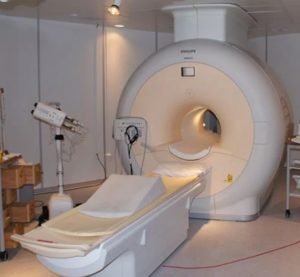
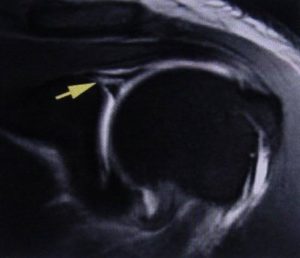
MRI is the best imaging modality for SLAP
Treatment
Conservative Treatment:
All patients should be treated non-operatively initially.
This consists of :
- Rest to allow the lesion to heal
- Physiotherapy
- Non- Steroidal Anti-inflammatory Medications
Surgical Treatment:
Those patients who fail to respond to non-operative treatment are offered Arthroscopic Surgery.
The type of surgery required depends upon the type of SLAP Tear.
The surgical options include:
- Arthroscopic debridement of the SLAP Lesion.
- Arthroscopic repair (fixing back the avulsed superior labrum and the biceps anchor back to the glenoid).
- Biceps tenodesis (re-attaching the biceps tendon to the upper end of the humerus). This is reserved for patients with frayed or torn biceps tendon. This can be done arthroscopic or open.