Articular Damage & Autologous Chondrocyte Implantation (ACI)
.jpg)
.jpg)
.jpg)
This is a two-stage procedure. The first stage involves an arthroscopic biopsy of normal cartilage from non-weight-bearing area of knee joint. The biopsy is then sent to cartilage expansion laboratory where the cells are cultured and multiplied. It takes about 6 weeks for the multiplication of cells. The second stage involves the implantation of cartilage cells in the damaged area. This is done by an open procedure.
Advantages of ACI:
ACI is most useful for younger patients who have single defect larger than 2 cm in diameter. ACI has the advantage of using the patient's own cells, so there is no danger of patient rejecting the tissue.
Disadvantages of ACI:
It has the disadvantage of being a two-stage procedure that requires an open incision. It also takes several weeks to complete. Rehabilitation after implantation is also lengthy.
Stage 1:
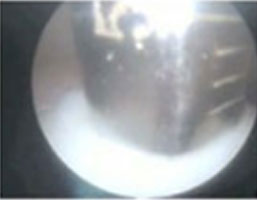
In this stage a biopsy of the healthy cartilage tissue is taken and sent for the culture to the laboratory where this material is grown into millions of cartilage cells. During this arthroscopy associated injuries like Meniscus Tear or ligament tears are dealt simultaneously. It takes about 6 weeks for the cells to be cultured in the laboratory, after which they are sent in sterile condition to the theater during implantation.

Defect seen in Healthy Cartilage
Biopsy

Healthy Cartilage

Healthy Cartilage
Stage 2:
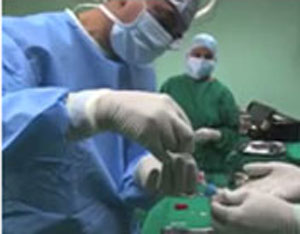
This is the stage of implantation of the cells onto the defect. This surgery is an open surgery. The cartilage defect is prepared so as to create a crater which is contained on all the sides.
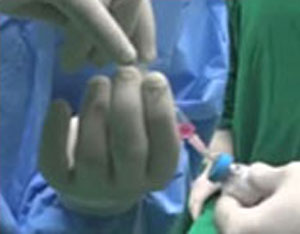
The cultured cells then implanted over the defect in a uniform manner from periphery to center to create an even and smooth surface. The cartilage cells are in Gel form which consolidates over the defect in about ten minutes to give a uniform feel.

Cartilage Defect

Before Implantation
Cells being loaded
Loading of Cells
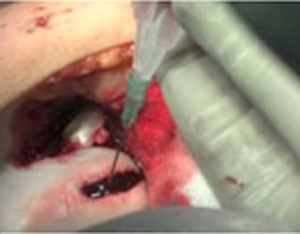
Injected-on-defect
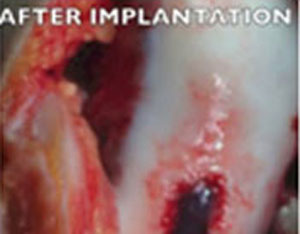
After implantation
Rehabilitation:
- The rehabilitation is slightly lengthy and complex.
- The CPM is initiated immediately and is increased depending upon the defect location.
- Begin 0-30 degrees on day 1 then increase 10 degrees/day or as tolerated.
- Patient is at non-weight-bearing stage for 8 weeks, partial weight-bearing stage from 8 to 12 weeks and full weight-bearing stage from 3 months onward.
- Knee Bending is allowed as tolerated but generally we expect Knee bending till 90 degrees by 3 weeks and 120 degrees by 6 weeks and complete Knee bending by 8 weeks.
Results after 3 months: